The racist deterrence of migration is becoming increasingly central to German border policy – even as businesses depend on migrant workers. What lies behind this shift, and how can the left respond?
On 30 March 2026, during the first state visit of Syria's transitional president, Ahmed al-Sharaa, German Chancellor Friedrich Merz declared that 80 percent of Syrians living in Germany should return to Syria. The right-wing AfD party welcomed the statement, interpreting it as a move toward its own agenda of "remigration", and demanded the deportation of virtually all Syrians in Germany.
Progressive voices criticised Merz by pointing to the successful integration of many Syrians, as well as Syria's devastated economy and ongoing security risks, particularly for religious minorities. At the same time, many defended Syrian nurses, doctors and pharmacists as indispensable workers. Large-scale deportations, they argued, would be against Germany's economic and demographic interests.
Merz's remarks and the reactions to them reveal a deeper political conflict. On one side is a racist and nationalist project that seeks to drastically reduce the presence of people constructed as "foreign" in Germany through mass deportations, regardless of the economic costs. On the other side stands an unstable alliance of progressive and neoliberal forces. While they speak the language of human rights, they also emphasise the value Syrians bring to the German economy and society: as a solution to labour shortages, an aging population and an increasingly fragile pension system.
The Rise of Progressive-Neoliberal Migration Management
The debate over Merz's statement reveals a tension that has shaped German migration policy throughout its history: the conflict between nationalist exclusion and the demand for a flexible industrial reserve army of labour. This tension can be traced back to the debates surrounding the immigration and settlement of Polish workers – the so-called Ruhrpolen – in Germany's Ruhr region before the First World War and during the interwar period. It continued through the so-called guest worker and contract worker programs after 1945 and still shapes contemporary conflicts over refugee migration.
Across these different periods, the same structural contradiction emerges in new forms: the tension between efforts to flexibly regulate both the mobility and immobility of working people in the interest of economic accumulation, and the equally persistent attempt to secure political stability at home through racist exclusion and border controls.
At the height of neoliberal globalisation in the 1990s, a new political project emerged to manage this contradiction: migration management. Framed by a rhetoric of economic usefulness and, in part, complemented by references to human rights and diversity, migration management seeks to contain and control autonomous movements of migration and displacement as a means of securing acceptance for the flexible admission of economically useful workers among migration-sceptical sections of the population. In practice, it combines the targeted recruitment and labour market integration of migrant workers with a restrictive – though still existing – asylum system, alongside policies of border enforcement, illegalisation and deportation.
Since the long summer of migration in 2015, however, right-wing forces have become increasingly successful in mobilising against neoliberal migration management. Much like the Trump administration in the United States, they have called for mass deportations. Merz's proposal that 80 percent of Syrians should return to Syria suggests that the way the contradiction between recruiting and deporting migrants is managed may be shifting in favour of a nationalist-chauvinist project. This project puts racism first and is willing to accept the resulting economic and demographic costs. If it prevails, it would mark the end of neoliberal migration management.
Conflicts Between Reproduction and Political Stabilisation
Within this broader struggle over the direction of migration policy, conflicts unfold on several interconnected levels. We can distinguish four overlapping dimensions.
The first concerns two competing approaches to mobility. On one side is the economic value of migration. When industries facing labour shortages struggle to maintain production, the flexible recruitment of migrant workers helps fill the gap, safeguarding competitiveness and profits. On the other side is the symbolic and material exclusion of migrants, which serves to stabilise political rule. Especially in times of crisis, directing public frustration towards migrants shifts attention away from the growing pressures people face at work, insecure pensions and the need for a genuine social and ecological transformation. Yet it is not only the far right that reframes social conflicts over housing, employment or pensions as questions of migration.
Beyond the far right, attacks on a society open to and shaped by migration have become a useful tool for political stabilisation. When former Chancellor Olaf Scholz, for example, announced that Germany should finally deport people on a large scale, he used the exclusion of migrants as an attempt to build support for his government's agenda. For businesses that depend on workers from abroad, however, this creates significant problems.
That is why parts of German industry increasingly warn that racism poses a threat to Germany as a location of production and investment. At this first level, then, two competing logics confront one another: the political stabilisation that racist policies may provide, and the need to sustain production by recruiting and retaining migrant workers.
The second level of conflict concerns the relationship between racist exclusion and social reproduction. In an aging society with an increasingly fragile pension and welfare system, migrants play a vital role in sustaining social reproduction. In recent months, there have been repeated warnings about Germany's declining birth rate, with many arguing that it threatens the long-term viability of both the welfare state and the economy.
At the same time, Syrian workers are already indispensable in the healthcare sector, caring for patients and older people while contributing to the pension system through their taxes and social security payments. The political project of mass deportations therefore stands in tension with social reproduction.
A third dimension is that conflicts are increasingly emerging both within the working class and between different fractions of capital. Public debate often focuses on highly skilled Syrian workers, obscuring the fact that there is no single, homogeneous group of "Syrians". Syrian men are concentrated in sectors such as transport and logistics, food services, healthcare and construction, while Syrian women are more likely to work in social and cultural occupations.
Although Syrians are, on average, more highly qualified than migrants from many other countries of origin, they also include unemployed people and workers in low-paid, low-skilled jobs. Their position in the labour market is therefore highly uneven. When these different positions are politicised through a distinction between "good" and "bad" migrants, they can deepen divisions and generate conflict among migrants themselves.
Nor does capital articulate a coherent demand when it comes to migrant labor. Export-oriented manufacturing firms, particularly medium-sized companies, depend heavily on highly qualified workers, whereas platform companies in sectors such as food delivery and logistics rely much more on precarious labour. The threat of mass deportations may endanger forms of specialised production, while at the same time creating a larger pool of vulnerable, easily exploitable – and in some cases illegalised – workers for other employers. Conflicts between business associations, for example over how to respond to the AfD, reflect this diversity of interests and reveal the underlying conflicts and distribution of power within capital itself.
Different Strategies Within Germany's Labour Regime
To understand the fourth dimension of these conflicts, the debate over returning Syrians to Syria – and the emphasis on their economic and demographic value – must be situated within the broader context of Germany's labour regime and the different strategies it employs.
Both the state and companies have a range of strategies for responding to shortages of low-cost or appropriately qualified labor. From this perspective, Merz's proposal that 80 percent of Syrians should return can also be understood as an attempt at intimidation. The constant threat of deportation and insecure residency pushes people to accept low wages and precarious working conditions that they might otherwise resist.
In this light, the current government's labour strategies – including longer daily and weekly working hours, mandatory medical certificates for sick leave and the continued expansion of automation – are closely connected to the strategic use of Syrian workers as a labour resource. Despite their differences, these strategies pursue the same objective: reducing costs and increasing productivity in response to the current weakness of the German and European economies on the global market.
If the nationalist-chauvinist project of border closure continues to gain ground, labour market strategies such as recruiting skilled workers or integrating asylum seekers into the labour market may become less important. In that case, improving profitability would increasingly depend in particular sectors on intensifying the discipline and exploitation of the workers who are already in the country.
Polarisation After the Possible End of Migration Management
In recent years, political mobilisation against migrants has deepened divisions between workers. The AfD now enjoys broad support among workers and trade union members, often despite the party's opposition to their material interests. At the same time, the alliance ranging from market liberals to progressive liberals has steadily lost support. In parallel, left-wing mobilisation against these divisions has grown stronger. As a result, conflicts over migration policy might intensify.
The current government's agenda attacks not only the right to freedom of movement but also many of the historic achievements of the labour movement. Both developments increase the pressure on workers. Yet this double attack also creates the potential for a shared political response and mobilisation. As these contradictions intensify, they may provide the basis for a broader movement against exploitation. Initiatives such as Unteilbar and the resurgence of the parliamentary left point to the potential for a unifying left-wing politics.
The central question for the left is how to successfully mobilise politically around these contradictions. The dominant response to Merz's proposal has been to stress the economic usefulness of skilled Syrian workers. A genuinely left-wing response, however, should not stop at exposing the racism behind his remarks. It must also challenge the underlying logic of usefulness itself and develop strategies that confront both authoritarian-neoliberal and fascist responses to the current crisis.
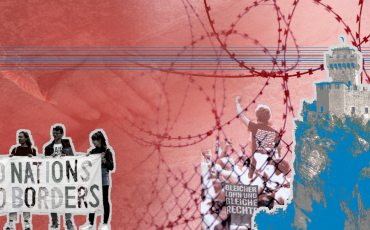
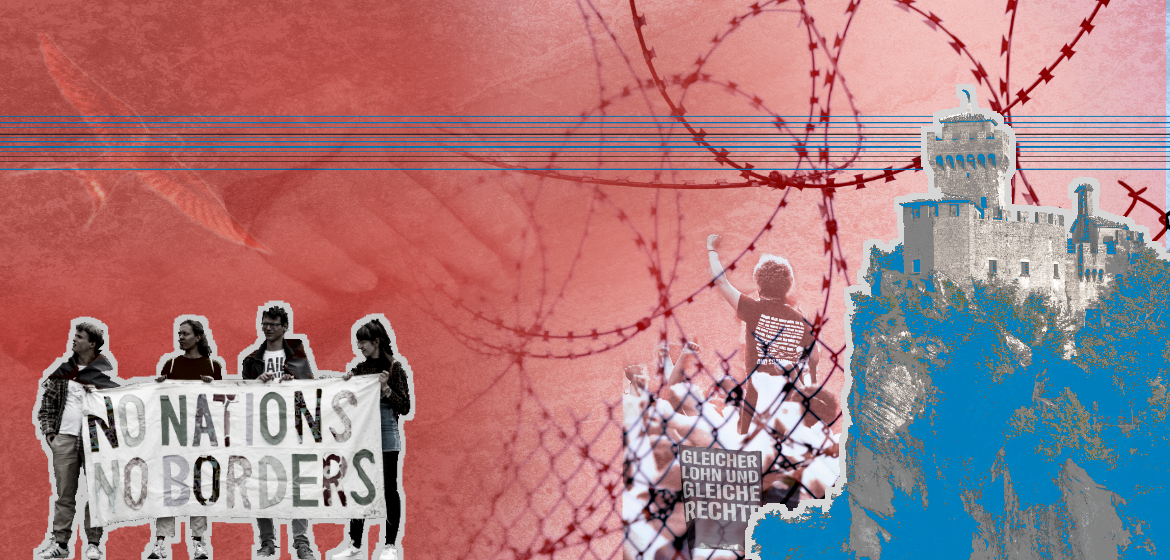
One possible element of such a strategy could be the politics of freedom of movement. It treats migration as a fundamental right and calls for the abolition of borders. Closely linked is the demand for equal rights for everyone, regardless of citizenship. At its core is a shared struggle against exploitation – refusing to divide along national lines. Rather than defending the remnants of progressive-neoliberal migration management by appealing to humanitarian concerns or the economic value of migrant labour for the national economy, this may be the moment for a more proactive alternative: migration policies rooted in solidarity and socio-ecological transformation. Such policies would be guided neither by calculations of economic usefulness nor by nationalist thinking, but by the emancipatory principle of freedom of movement.