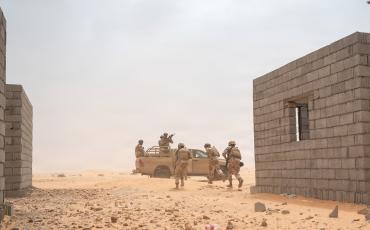
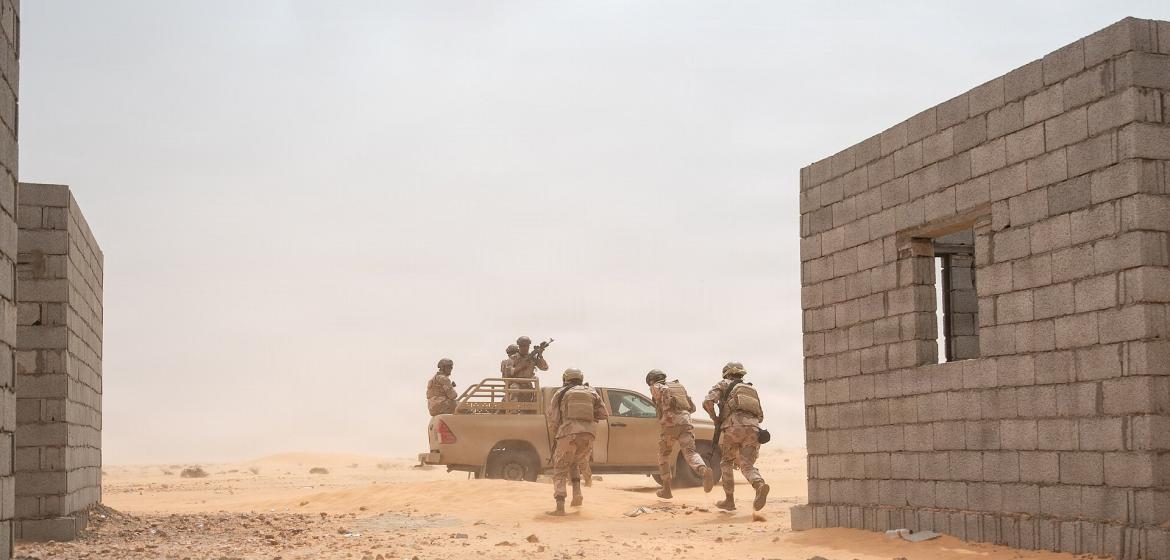
Libya, once a regional powerhouse, has become a battleground for foreign interests. Khalifa Haftar, profits from allowing foreign actors to use the territory under his control for military operations.
Following the overthrow of Muammar al-Gaddafi in 2011 and the civil war that erupted afterwards, Libya has experienced economic and political instability and persistent internal fragmentation. Today, the country is effectively divided between two main power centres: the internationally recognized Government of National Unity (GNU) in Tripoli in the west, supported by the EU and Turkey and forces in eastern Libya under the command of Khalifa Haftar, backed by the United Arab Emirates, Egypt, and Russia.
This division, combined with competing external interests in the country, has turned Libya into a complex geopolitical arena where regional and international powers pursue strategic influence, often at the expense of the country’s stability and sovereignty. Consequently, the political landscape we encounter in Libya today is no longer limited to domestic power-sharing but has increasingly evolved into a playground for foreign actors. Within this context, particularly Khalifa Haftar appears to trade his hold on power for the erosion of Libya’s wealth and sovereignty, turning the country into a logistical hub for mercenaries deployed by his regional and international allies in active conflict zones.
It is important to note that the use of foreign fighters is neither limited to one side of the Libyan conflict nor to the current cycle of conflict. During the 2019–2020 Libyan civil war, forces aligned with the Tripoli-based government also relied on foreign combatants, particularly Syrian fighters deployed with Turkish support. While such involvement was largely tied to the internal dynamics of the Libyan conflict, more recent patterns suggest that parts of Libya, especially in the east and south, are increasingly integrated into wider regional networks of transnational mercenary deployment.
Colombian mercenaries and war in Sudan
Today, the eastern region of Cyrenaica under Khalifa Haftar’s control, has become a core part of a complex logistical network funded by the UAE to support their proxies in the current war in Sudan, the Rapid Support Forces. Recently, Sudan filed an official complaint to the UN Security Council, accusing the UAE of recruiting and funding between 350 and 380 Colombian mercenaries, most of them retired soldiers and officers, to fight alongside the Rapid Support Forces in Darfur.
Reports also reveal that many of these recruits, some barely past their teenage years, are deceived with promises of legitimate, well-paid security jobs in the UAE, only to be deployed to active conflict zones. After having their phones and passports confiscated upon arrival in Abu Dhabi, those mercenaries, operating under the codename “Desert Wolves” are then flown from the UAE to Puntland in Somalia, and from there to Benghazi. Upon their arrival in Libya, they are put under the supervision of Haftar-aligned forces, before crossing the desert into Sudan, ultimately ending up in training camps in Darfur where they are forced into one of the world’s most brutal wars. Benghazi’s port and airport serve as a vital transit node for mercenaries and weapons, which shows that Libya’s sovereignty has become a tradable commodity.
Russian geopolitical interests in Sub-Saharan Africa
Parallel to the UAE case, another major power has firmly established a military foothold in southern Libya: Russia. Mercenary groups and private military companies such as Wagner, rebranded mid-2023 as Africa Corps, have exploited the security vacuum and weak central control in Libya to establish informal military footholds since at least 2017.
Since the start of the Libyan conflict, the country’s south has become a staging ground for Russian operations and influence across the Sahel. In countries like Niger, Burkina Faso, Central African Republic, and Mali, Moscow offers security assistance in exchange for economic concessions and political leverage, especially after the French withdrawal from those regions.
Haftar appears to provide Russian mercenaries with protection and logistical support in exchange for sustained military and political backing. An arrangement reminiscent of Cold War-style proxy dynamics, where weak states served as battlegrounds for global rivalries at the cost of their internal stability.
Fragmented political authority in the Fezzan
Control over southern Libya, particularly the Fezzan region, remains highly fragmented. It is shaped by local armed groups, most notably the Tubu, Ouled Slimane, and Tuareg forces, together with local militias affiliated with Haftar. These groups play a crucial role in controlling border areas and desert routes that connect Libya to Chad, Niger, and Sudan. These routes are not only used for the movement of mercenaries and military assets but also serve as smuggling route for goods and people. The Fezzan is embedded within a wider context of legal and illegal economic networks extending from Libya to its southern neighbours.
The region has been a historical transition zone for trans-Saharan trade. Today it has yet again emerged as a key corridor for cross-border movements. Political fragmentation and a limited presence of state authority have enabled both local actors and external powers to exploit these dynamics, reinforcing the Fezzan’s role as a logistical hub in broader regional conflicts.
Khalifa Haftar’s expansion into southern Libya since 2018 has further reshaped these dynamics. Rather than establishing direct and stable control, Haftar has relied on a strategy of selective co-optation, forming tactical alliances with segments of the Tebu and Ouled Slimane militias. At the same time, other factions have resisted or shifted positions depending on local power calculations. The result is a fluid political landscape where authority is negotiated rather than imposed.
Maintaining Power Through Foreign Backing
By facilitating mercenary activities, Haftar presents himself as an indispensable partner to the UAE and Russia, ensuring continued military and diplomatic support for his rule in eastern Libya.
What stands behind this political calculation is the intention to fortify his own domestic position and legitimacy through foreign backing, which gives him a decisive military advantage over his rival, the GNU in Tripoli. Simultaneously, foreign backing shields him from meaningful international pressure to pursue a political settlement that could cost him his authority.
While most of the international community publicly supports an UN-led political solution in Libya, their actions increasingly reflect an accommodation of the status quo rather than pressure to overcome it. The Security Council described the political process as “deadlocked” in February 2026. Nevertheless, the UN mission UNSMIL continues to promote institutional unification and a political roadmap as a solution to the crisis. This situation illustrates how external actors with an interest in Libya’s internal division prefer a controlled and negotiable division of power over the risks of a genuine political reset.
Economic sovereignty and the role of oil
Moreover, benefiting from foreign military support has also strengthened Haftar’s control over crucial natural resources. In the past, Haftar consolidated control over key oil production areas in central Libya and export infrastructures in the East. This allows him to strengthen his bargaining position vis-à-vis national or international institutions, effectively translating military dominance into economic and political leverage. Through selling oil and fuel via privately owned companies such as the Arkenu Oil Company, Libya’s resources have become increasingly tied to external actors, holding leverage over such transactions.
While for many Libyans, sovereignty may seem abstract amid ongoing economic challenges, militarization and eroding sovereignty have tangible day-to-day consequences. Those include societal polarization, the entrenchment of armed groups, weak and fragile state institutions, and a reduction of the state’s capacity to respond to unexpected crises such as the deadly collapse of two dams in Derna in 2023. For the population, such developments are an immediate reality, reflected in economic volatility, unreliable public services, and perpetual cycles of uncertainty and insecurity.
In his bid to secure his rule, Haftar is not merely compromising Libyan territory; he is fuelling regional conflicts and reaping benefits today that future generations of Libyans will pay for. He has turned Libya from a state of wealth and influence into nothing more than a dirt road cutting through the desert of global conflict. This role benefits only the ruling elite aligned with him, while the Libyan people pay the price in their stability, security, and future.
A revised version of this article was first published by Alash Media.