
Several months after the fall of al-Fashir, the army’s last stronghold, the conflict in Sudan has entered a new phase. Sudanese women’s rights activist and founder of the “No to Oppression against Women” initiative in Sudan Amira Osman Hamed speaks on the matter.
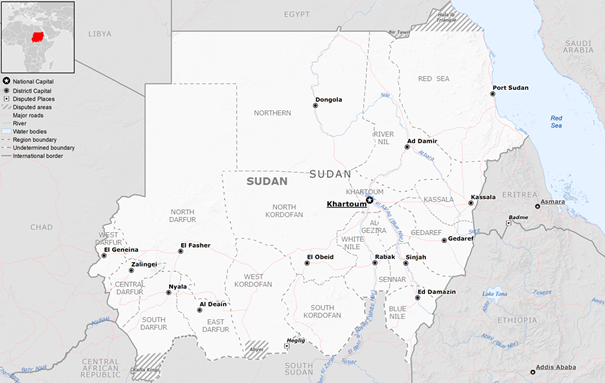
In October 2025, al-Fashir—the Sudanese Armed Forces’ (SAF) last stronghold in Darfur—fell to the Rapid Support Forces (RSF) after more than 500 days under siege, leaving the RSF in control of the region. What does this mean for the trajectory of the war?
The fall of al-Fashir was tragic. The city was not defeated by fighting, but by hunger, thirst, and disease. The army’s defeat and withdrawal led to the massacres we had always feared: genocide, mass killings, and grave human rights violations. The RSF killed, buried people alive, and burned villages and their inhabitants, regardless of age or gender. Women were especially targeted. What made it worse was that the perpetrators joked, cheered, and filmed their actions, believing they would face no consequences. Their crimes must never be forgotten, and they must be held accountable.
How are women specifically affected by the current war in Sudan?
Since the war began on April 15th, 2023, we have been raising our voices against the use of women’s bodies as battlefields. The RSF’s victories have brought widespread abuses against civilians, particularly women, including being sold in markets, subjected to sexual slavery, held hostage, and forced to work without pay, food, or medical care, often until their deaths.
They have endured every imaginable violation of human rights, without mercy. Women have also faced punishment or execution by the SAF on charges of collaboration when trying to flee RSF-controlled areas. Women in Sudan are facing a war waged against them by both the RSF and the army.
Turning to the ethnic groups historically inhabiting the Darfur region, which of them are most affected by the rule of the RSF, and why?
Historically, the RSF, largely claiming to be “Arabs”, have held grudges against non-Arab tribes in Darfur. These tensions were fuelled by past governments that armed Arab tribes to suppress rebel movements in Darfur, South Kurdufan, and the Nuba Mountains in the early 2000s.
Additionally, there are deep-rooted farmer-herder conflicts between Arab tribes, who largely follow a pastoral livelihood, and the non-Arab tribes, who have historically been engaging in agriculture. While there was once a system for resolving these disputes, including blood money payments, due to a strong polarization today’s conflicts in Darfur are often based on ethnicity and religious beliefs.
This manifests in ethnic cleansing aimed at reshaping the region’s demographics through displacement and land seizure. An example of this is Jabal Amir, home to one of Sudan’s largest and most productive gold mines, where all Indigenous tribes have been displaced or wiped out; today, the RSF controls the area.
Which external powers are involved in the conflict, and what interests drive them?
International interests play a major role in the current war, with both neighbouring as well as regional powers intervening. As the state weakens, the more it loses sovereignty and control; neighbouring countries support the forces that serve their own interests.
The UAE, for instance, has supported the RSF with weapons, logistics, and soldiers, often channelled through countries like Central Africa, Libya, Chad, Kenya, and Uganda. This has allowed the RSF to maintain pressure and continue fighting. Additionally, young men from West African and Sahelian countries like Niger have joined the RSF, seeking economic gains from looting and plunder.
At present, one area of Sudan remains under army control, while another—practically all of Darfur—is under the control of the RSF. Does Hemedti (Muhammed Hamdan Dagalu Musa, head of the RSF) want to establish a separate government in Darfur?
The RSF does seek political legitimacy, which is why Hemedti has pushed for alliances with civilian actors in Darfur. Yet, it has eliminated any potential popular support by turning citizens into its primary enemy. Even after seizing large parts of the capital and much of central Sudan by 2024, the RSF failed to build institutions or provide basic services. Instead of consolidating control, it has destroyed civilian life wherever it entered.
The RSF’s actions show it cannot build stability; it is incapable of governing. Although now there is a so-called “government of action”, I do not believe this will lead to the country’s division.
After the massacres in al-Fashir, it is clear what atrocities the RSF is capable of. If the international community were to designate it as a terrorist organization, arms deliveries could be halted, as the United States has already called for. Without external support, the RSF would face great difficulty continuing its activities and could eventually disappear from Sudan’s political life.
After the fall of al-Fashir, there appeared to be a renewed interest in the war in Sudan. How do you perceive this increase in public attention now, particularly concerning media coverage?
Media interest increased, especially after the war in Gaza formally ended. Attention shifted to Sudan in Europe, the United States, and the Arab world. I believe in people’s solidarity and am convinced that citizens can urge their governments to advocate for peace and security. The world was deeply concerned about the massacres in Gaza, and this global solidarity demonstrated the power of public pressure on political leaders. Now that an official ceasefire is in place there, I hope that this attention will finally turn to Sudan.
In a regional context, the wars in Gaza and Sudan reveal geopolitical parallels. Sudan is seen as a strategic gateway to West Asia that Israel seeks to secure, also because of its ports, agricultural land, and Nile waters in the east. Moreover, Sudan is to be deterred from supporting Palestine. The normalization efforts with Israel driven by the United States, as well as meetings with the military leaders Hemedti and Burhan [General Abdal Fattah al-Burhan, head of the SAF, ed. note], underscore this.
Looking ahead, what are the possibilities for peace in Sudan?
At present, I do not see peace in the near future. However, I hope for a comprehensive peace that addresses the root causes of the conflicts and leads to a civilian state with a national constitution for all citizens. A peace that promotes development, uses resources for the benefit of the population, and shapes international relations in Sudan’s best interests.
Generally, the governments coming to power in Sudan have always tended towards peace treaties that appease the killers or the war generals, ultimately encouraging them. The emphasis on the idea that wealth and power can be attained through weapons, killing, and the distribution of ministries and money is misguided. It implies a division of wealth and power that does not benefit the Sudanese people. Such fragile peace agreements, including the so-called “just peace”, which resulted in the division of the South in 2011, ultimately resulted in a government worse than the one in northern Sudan. The situation stayed the same: corruption and the accumulation of power prevailed.
We hope for genuine peace, a civilian state, and a reorganised national army that protects the state while remaining apolitical. Ultimately, peace must endure beyond wars, and I hope Sudan can avoid disintegration, allowing its people to build a state that resembles what the revolutionary people of Sudan have imagined it to be.
You are currently living in Germany. How can people in Germany or Europe express solidarity with the Sudanese people?
We Sudanese need the solidarity of the German people, and one can raise awareness about the situation in Sudan and pressure parliament to ensure the German government does not support the UAE or provide weapons to the RSF.
Although the UAE has limited domestic military capacity, it is one of the largest arms purchasers, and much of its imported weaponry is eventually used in Sudan.
As ultimately, the purpose of wars is economic profits, another imperative is to exert pressure on Emirati investments in Germany to reach stability in Sudan and the security of its citizens.
The interview was held in Arabic and translated by the author.