Mauritania has intensified deportations of West African migrants while increasing discrimination and policing against Black Mauritanians. Anthropologist Elhadj Ould Brahim explores the social exclusion and inequality behind these actions.
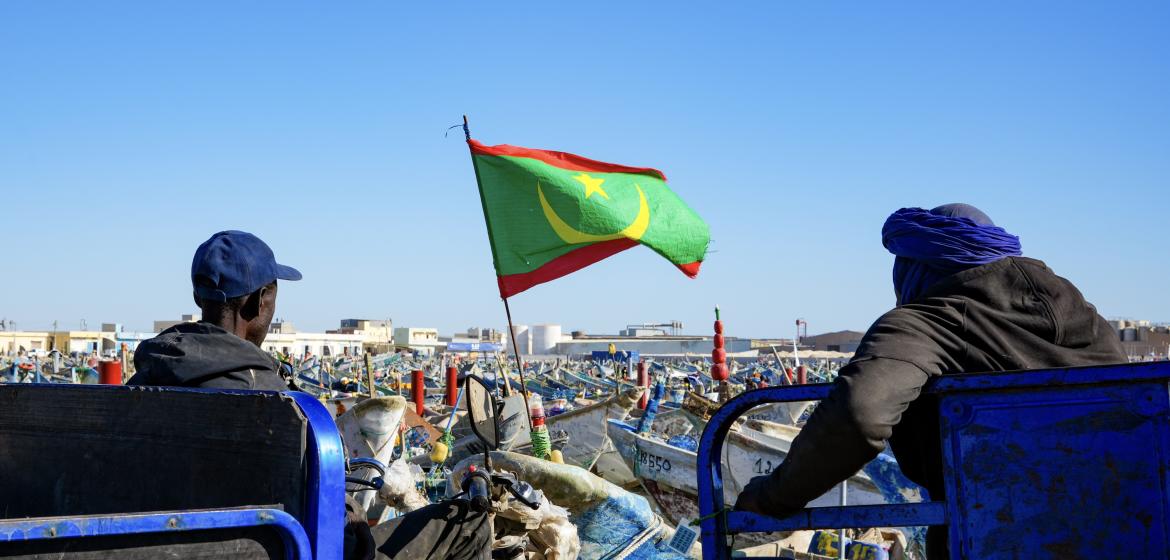
Since spring 2025, Mauritanian authorities have been deporting sub-Saharan migrants – both with and without residency permits – as well as Mauritanian citizens to Senegal and Mali. For those Mauritanians who are racially categorized as Black within Mauritanian society, these expulsions evoke painful memories of the mass deportations and violence during the Mauritania-Senegal conflict of 1989.
In conversation with dis:orient, Elhadj Ould Brahim, a Mauritanian anthropologist at the Institut des Mondes Africains in Paris, discusses the country’s migration and identity policies, and explores the deeper social dynamics shaping Mauritanian society today.
How has the recent wave of deportations impacted the social climate in Mauritania?
The recent racist and xenophobic campaign directed specifically at West African Migrants was unprecedented in scale. An essential number of those entering Mauritania do so with the plan to embark from there towards the Canary Islands, making the recent crack-down a symptom of EU-border externalization. The deportations were initially meant to address the increasing influx of immigrants and refugees caused by regional conflicts in the Sahel countries, but they turned out to be a maneuver to manage internal issues where questions of racism and still ongoing slavery are subjects of a political and legal debate. The marginalization of the vast majority of the population – whether Haratin or Black African Mauritanians who are both defined as Black in Mauritania – remains a major structural problem that manifests in all internal and external debates.
What has motivated this recent crack-down?
The recent state driven campaign was motivated by a memorandum signed with the EU in March 2024 that is part of broader security policies to externalize the EU’s immigration policy. For some Bidans who represent the politically dominant ethnic group, the news of this agreement sparked fears of a “great replacement”. Social media became the battleground for a xenophobic campaign, led by racist demagogues and people openly calling for a “Bidan supremacy” and a country cleaned from Black immigrants – and eventually, without Black citizens.
The fact that some Mauritanian nationals also find themselves victims of the deportation campaign is partly due to the lack of documents. Can you tell us how the ID system in Mauritania came to be implemented?
The new biometric national ID system was created under the former president Mohamed Ould Abdel Aziz in the early 2010s, but the complicated procedures made it very hard for Haratin or Black African Mauritanians to acquire national documents among others due to lacking documents from parents and discrimination by the administration. ?In May 2025 ten young Black African Mauritanians who lacked national documents were wrongfully arrested with the intention to deport them.
And this is not the first time we’re seeing deportations of nationals, right?
Exactly, deportation initiatives like the one today reopen still unhealed wounds of what is known as the 1989 Events between Mauritania and Senegal. The 1989 Events – often referred to in Mauritania simply as les évènements (the events) – mark one of the most painful chapters in the country's recent history. The crisis began in April of that year with a violent clash between Senegalese farmers and Mauritanian herders along the border sparked by disputes over land use and grazing rights. What started as a local conflict quickly escalated into a major diplomatic rupture between Mauritania and Senegal unleashing weeks of racial violence, state repression, and mass human rights abuses on both sides of the border. During this period, an estimated number of 70,000 Senegalese living in Mauritania were deported or repatriated under duress. At the same time, more than 120,000 Black African Mauritanians were stripped of their citizenship and forcibly expelled to Senegal, while 20,000 others fled to Mali to escape persecution. Dozens were killed in their homes or in the streets by armed groups, and at least 530 Black African Mauritanian soldiers were executed in military detention camps, according to reports by Human Rights Watch and the Collective of the Victims of Repression (COVIRE). The violence left behind a deep scar in Mauritania's social fabric – one that continues to shape national memory, interethnic relations, and the experiences of returnees and their descendants.
How does Mauretania’s society look at the country’s diversity today?
The Mauritanian social model is a rich and diverse mosaic, reflecting the diversity of both the Northern and Southern parts of the African continent. Still, the country and its post-independence elites have failed to invest positively in this diversity. They do not see it as a source of strength, but rather as a reason for division. Beneath the Black-white dichotomy, lie deeper social hierarchies rooted in enslavement, marginalization, and stigmatization of various subaltern groups – Blacks and whites alike – including the Haratin, the Maalmin (artisans), and other social strata. This results in a semi-open, semi-closed social system where lineage matters more than race or color. Women are also still underrepresented in all socioeconomic structures. In this sense, the Mauritanian society remains fragmented. Only God knows what will bring the different parts of society together.
What challenges are there specifically for the Haratin in Mauritania?
Like many countries in the Global South, Mauritania continues to struggle with the idea of a cohesive nation-state and with the transition out of tribal systems in the post-colonial era. The Haratin face a double challenge: They are denied political recognition and socio-cultural visibility , despite representing about 40% of the population. Their situation is not necessarily better than that of Black African citizens.
Bidan elites have historically tried to play addition-and-substitution games with the Haratin in failed efforts to “balance” the demographic scale. Sometimes this means denying Haratin their Black origins, claiming instead that they are Bidan – which is ironic, since "bidan" means “white” and the Haratin are largely believed to be descendants of enslaved Black populations. This addition tactic was designed to pit Haratin against Black African Mauritanians and Migrants – a strategy that worked in the past, notably during the 1989 Events when Haratin were used as “beating sticks” against Black African Mauritanians and Senegalese, seizing their property in several cities and the Senegal River Valley.
Is the current situation for Black Mauritanians only connected to racism?
I think the problem of Black African Mauritanians cannot be separated from the wider structural failures of the modern state. It is true that tribalization and ethnicization of state structures have created a de facto Bidan state – marginalizing Haratin, Black African Mauritanians, and even poor Bidans alike. The continuation of such structural injustices will only lead to more fragmentation and inequality, making social explosion a matter of time and circumstance.
How does police behavior play into that?
During the first two years of the current government (2019–2022), according to my findings, the state police cracked down and imprisoned 130 citizens – on average, one incident per week. The killing of 12 Mauritanian citizens in 2020 including four youngsters in the June 2024 presidential election speaks volumes about security forces’ brutality against ordinary people – students, women, activists, workers, and abolitionists.
Do you have any predictions on future social developments in Mauritania?
The open skies and the advent of social media bring not only notorious voices of xenophobia, religious extremism, and other social ills, but also empower activists, bloggers, whistleblowers, abolitionists, and human rights defenders of all kinds. The recent waves of emigration could play a constructive role in reshaping the country's social future. Exile often creates distance from entrenched norms and exposes individuals to new ideas of coexistence and equality. From places like the U.S., where race, class, and identity are negotiated differently, Mauritanians may return or influence from afar with new perspectives that challenge rigid hierarchies back home. Even if gradual, such exposure might help foster a more inclusive social vision. Or at least, that is my hope.