In her short film “Villa 187”, filmmaker Eiman Mirghani captures the quiet unraveling of her home in Qatar—a loss that feels like a second uprooting for her Sudanese family.
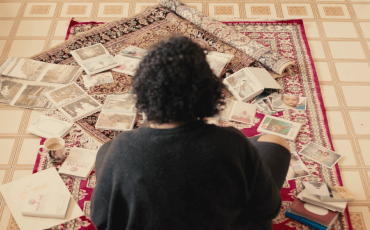
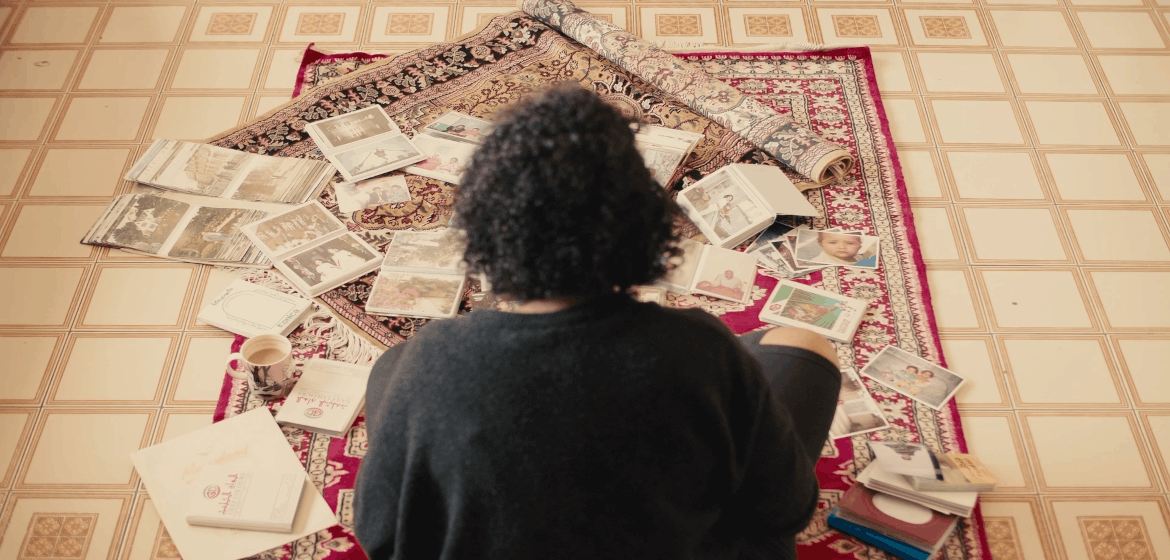
Ping. The sound of an iPhone notification. A melodic, deep voice starts talking in Arabic: “Eiman, my beautiful girl. How are you? I am sending you this voice note to tell you something important. I am about to retire.” Listening to the voice note, a woman is skimming through pictures. A family album: sepia photographs of a man posing at a waterfront, the same man in a university gown at a graduation ceremony. She goes on to open a cabinet filled with video tapes.
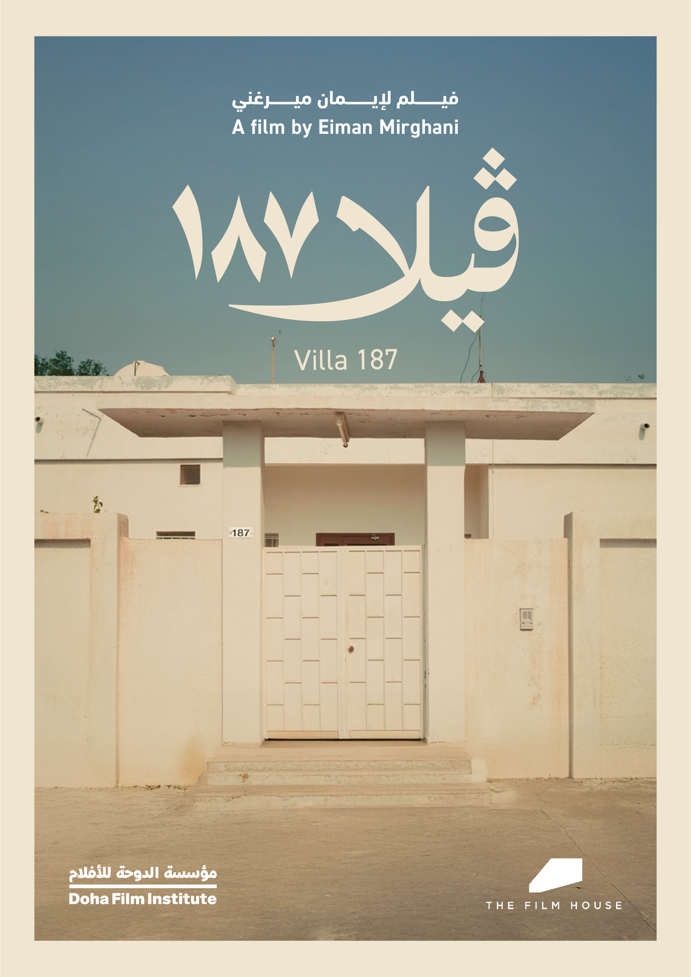
A cut. Black and white flickering, shaky video sequences of the photographed scenes begin: a wedding. The young couple exchanges rings, a band is playing in the background. Another cut. The camera is pointed at the gates of a bright concrete building, guarded by a wall and a crème-colored metal door. A black and white plate shows the house number: 187.
“So, we will leave our home in the compound. The home that you were all born in”, the voice goes on.
Finding her voice through film
The scene described opens the short film “Villa 187”, directed and produced by Sudanese filmmaker Eiman Mirghani. It premiered in November 2025 at the Doha Film Festival as part of the “Made in Qatar” program, where Eiman won the award for best director. The film is her third, following the short film “The Bleaching Syndrome”.
Dis:orient had the chance to talk to the director a few weeks after the premiere: “I always wanted to be a filmmaker. My parents were not too happy about it. As a third culture kid growing up in the Gulf with Sudanese parents, they wondered: what am I going to do with a film degree?”, Eiman recalls. After graduating with a bachelor’s degree in film and media studies, she started to work at the Doha Film Institute: “They really nurtured me as a filmmaker. Coming back to Doha Film Festival, showing my film there, and winning an award felt like a full-circle moment.”
Growing up in a place that was never permanent
Another shot: the camera zooms in on the passport that Eiman is flipping through. Jumhuriyyah al-Sudan (en.: Republic of Sudan), it reads on the cover. “Qatar has started to become perhaps more of a home to us than our homeland itself. To you and your sisters, it is home”, the recorded voice of her father calmly goes on.
Eiman Mirghani was born and raised in Qatar by Sudanese parents. The family’s residency status depended on her father’s work sponsorship, a situation that, she reflects, was marked by a persistent sense of insecurity throughout their more than 30 years in the country: “Being born in Qatar does not mean that you are Qatari. Anyone living in the Gulf but not originally from the Gulf knows that their time there is limited.” She nevertheless underscores that her family’s situation was comparatively secure, especially when set against the countless Sudanese who have been forcibly displaced by the ongoing war that started in April 2023.
Documenting the unraveling of a home
“We knew that there was a ticking time bomb: at a certain point we would all get the message that we have to leave because we were under my father’s sponsorship.” When that day finally arrived, Eiman’s father sent her and her sisters a voice note that would eventually become the narrative thread of losing their family home, Villa 187. It prompted her to document the process of packing and moving through the medium she knows best: film.
Together with her cinematographer, Baris Konbal, she began filming on weekends. “I love this house. I grew up in this place. It's part of me. I felt like I needed to document it”, she recalls her first reaction to the news. When asked why her own voice does not appear in the film, but is instead led by her father’s voice, she replied: “We all received the voice note at the same time. And next thing we knew, we were packing up and had to leave. I wanted to present that reality in its truest form. I think this was the best way to do it.”
The continuity of a life in between
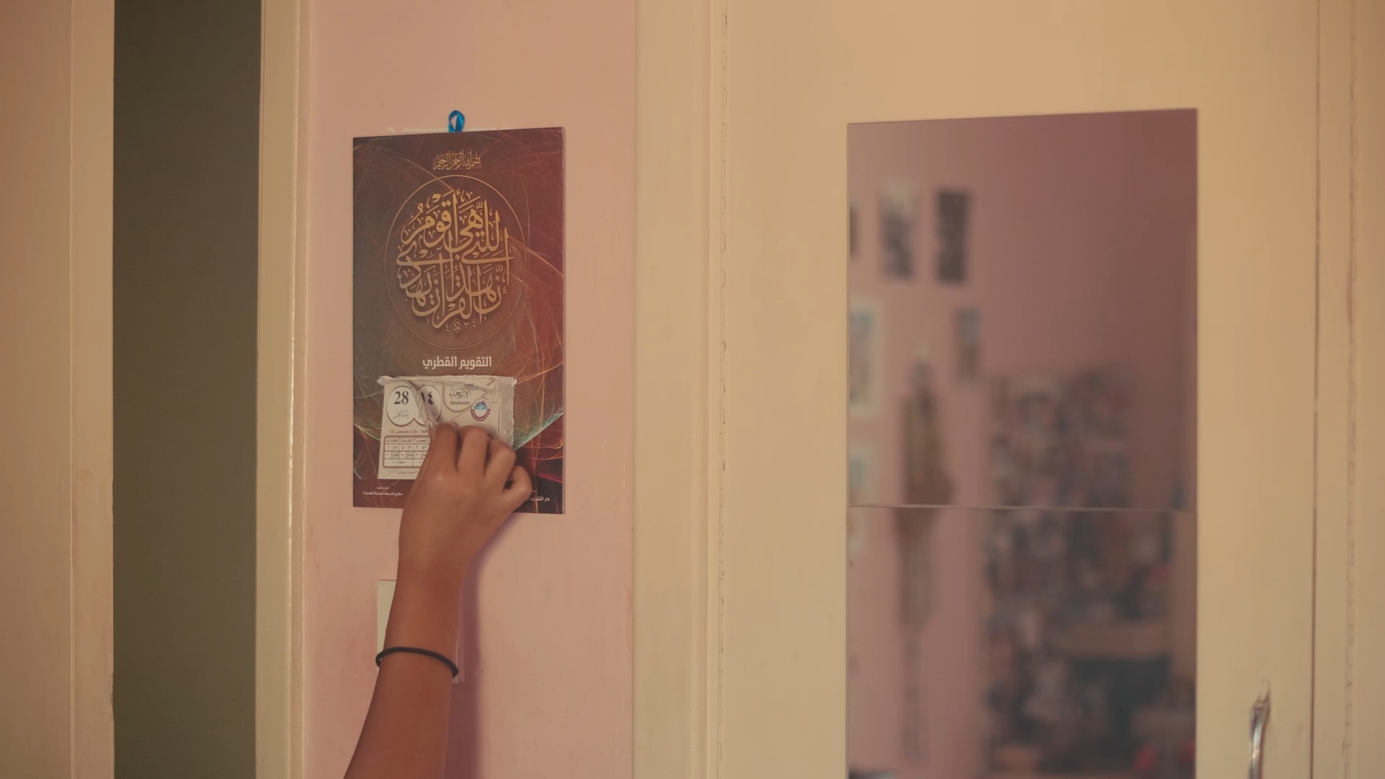
During the filming process, Eiman rediscovered her family’s VHS collection. She decided to digitize the tapes and to incorporate them into the film: “I felt a lot of sadness during the filming phase. It was in the post-production phase where the film really came to life. I rediscovered those memories and put the film together with their help.”
Watching the film, it becomes apparent that Eiman is negotiating more than just the loss of the physical building she calls her family’s home. “I think anybody who lives in a country that is not their own will always have some level of an identity crisis. You may be surrounded by friends and family from where you come from, but you're never truly at home.” Accordingly, she experienced the announcement of the move as a second uprooting in a life that had never truly felt rooted to begin with, because of her family’s uncertain status in Qatar.
The impossibility of a return to the homeland
At the time she learned her family would eventually have to move out, Sudan had just emerged from the revolution of 2018 and 2019 that led to the fall of long-ruling dictator Omar al-Bashir. There was cautious hope, she recalls, that the country was on a path to recovery. However, after the proxy war broke out in April 2023, it became evident that this was not the case, and that Sudan was not a safe place to live. As of May 2026, the Republic is on the brink of famine, with around two-thirds of the population depending on food aid. With almost 9 million internally displaced persons and 4.5 million Sudanese having fled to the neighboring countries, the UN describes the situation as the “world’s largest displacement crisis.”
As the war is ongoing, Eiman describes the search for a home as a state of limbo: “You don’t know where you’re going, and you can’t go back to where you come from. The biggest challenge for me was to make peace with the status quo”.
What makes a home?
Another scene. The screeching sound of tape sealing a box. Books piled up. A basket with toys, a teddy bear peeking out, the tinny sound from a mechanical music box playing in the background. A single nail in a white wall, signaling the frame that once hung there. Then the final shots: the kitchen, a bedroom, the hallway. Emptied of all belongings that could hint to the people that once called this place their home. One final time, her father’s soothing voice sets in: “There are no issues for you to worry about. Like I said earlier, I was expecting this scenario for a long time, and I have fully prepared for it. Inshallah (en.: God willing), everything will run smoothly. I love you so much”.
The screen fades black, the credits roll. Like the film, the conversation with Eiman slowly comes to an end. One question remains after following the journey of “Villa 187”: What does home mean to her? She sighs, then smiles: “I learned that at the end of the day, a house is a house. It is a building. Of course, you can have a lot of emotional attachment to it, but it is the people inside the house that really give you that feeling. I feel at home when I am with my parents, with my sisters. I feel at home with my very close friends. I am grateful that I am still able to have this feeling now, even after we left Villa 187.”