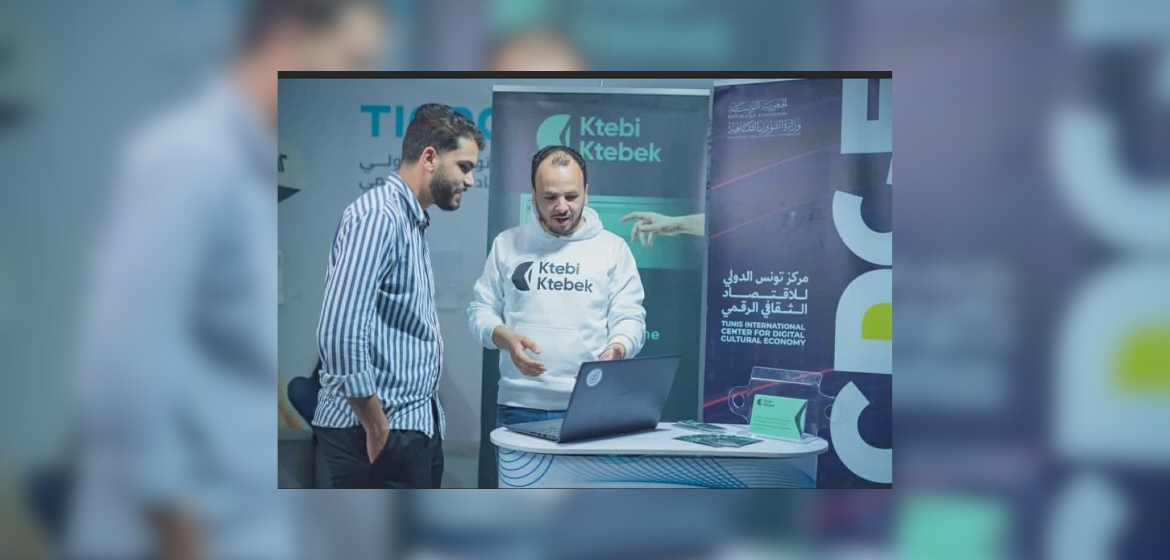
The internet age and rising inflation aren’t slowing Tunisia’s reading culture, but rather propelling reading habits. Mohamed Boumaiza, founder of Ktebi Ktebek, explains how his online bookstore is adapting to these changes.
In Tunisia, the secondhand book market is located in the capital Tunis mainly in Dabbaghine Street, passage and avenue Habib Bourguiba, where books have been collecting dust. Despite being affordable, this book market has seen a decline in customer consumption. It no longer adapts with the ever-changing customer demographics or the rise of popular authors and new book genres. This has led Tunisian readers to turn to imported books, which most often do not meet their purchasing abilities. Imported book prices range from 50dt to over 100dt.
The dinar’s decline and its impact on book culture
Today euro exchange rates to Tunisian dinar are alarming as one euro equals 3.42 Tunisian dinar. According to the Tunisian observatory of the economy the dinar lost 52% of its value against the US dollar from 2011 to 2022. The variation in the value of the dinar has never been as constant as it was during the last decade. CIDOB’s (Barcelona center for international affairs) opinion for 2022 suggests that successive Tunisian governments have been defying the laws of budget deficit gravity for so long that the country’s leaders seem to have convinced themselves they can indulge in magical economic thinking. A foreign debt at 100% of GDP, double-digit inflation, and shortages of staple foods suggest otherwise. In an economically challenged country like Tunisia, consumers can be price-sensitive to such items that are less of a priority, which may be one of the reasons why reading consumption are declining among Tunisians.
The struggle for affordable and sustainable reading
Rihem, a 23-year-old student, expresses with a mixture of appreciation and realism that “everybody likes affordable books but most of the secondhand bookstores in Tunis sell very outdated books and imported books are very expensive that students like myself cannot afford”. Not only the financial aspect is troublesome, the waste is also raising concerns among Tunisians which have become fed-up by the level of pollution: “It’s the plastic packages that come with books and every other item sold nowadays. We need less plastic, we have enough already”, she sighs helplessly.
Ranging from accessibility, purchasing abilities to environmental challenges, such gaps not only restrict access and make books financially out of reach for many, but also add a new layer of hesitation, as readers grow increasingly aware of the environmental toll of paper, further discouraging the habit of reading physical books.
On the bright side, these gaps have opened the door for online secondhand book markets like Hebdo livres, coin lecture , Ktob, livres pour tous and Ktebi Ktebek who have witnessed a wide recognition from a range of readers for encompassing a variety of books from classics to modern literature in French, Arabic, English and Italian. However, it was Ktebi Ktebek that had the vision that Tunisians like Rihem longed to see come to life, accessibility, affordability and sustainability altogether.
Ktebi Ktebek: Where books find a second life
We speak to Mohamed Boumaiza at the Tunisian book fair in November 2025. He is the founder of Ktebi Ktebek which translates to “My book is yours”, an online secondhand bookstore. Mohamed is a 35-year-old user-experience design specialist who carries a smile that easily puts people at ease. At the fair, the young man is surrounded by individuals eager to capitalize on reading ventures in a welcoming atmosphere where books are passed down like treasures to bookaholics. Interestingly, Mohamed came with secondhand books to a book fair that celebrates mostly brand new books. His business provides not only an accessible and budget friendly solution for Tunisian readers and an eco-friendly alternative for the environment but also a selling outlet for traditional secondhand book vendors. When asked about his love for books, Mohamed says with a spark that crossed his eyes that “it’s food for thought, it matures people, and it has the power to transform them from humans to people in society.”

He recalls with a nostalgic smile: “I remember looking at my library and thinking I’d read most of the books there. I might as well give them to someone who’d like to read them, because they were not frequent in Tunis at the time.” Mohamed then takes a step back, as if reconsidering his decision: “However, I realized that it requires investing effort and money for people to value something.” He spoke with the calm conviction of someone who had learned that sharing ideas could be as challenging as collecting them. That decision marked the beginning of his efforts to make books more accessible. Knowing the increasing prices of books in his country, Mohamed thought of a better plan, profitable for book lovers, himself and the environment.
A win-win for readers, vendors, and the planet
Mohamed created a Facebook account where he listed the pre-loved books for sale, prices ranging from 15dt to 25dt depending on the physical state of the book. To his surprise, he started getting orders from the first day. So far Ktebi Ktebek has secured more than 1000 orders since its launch in 2020. Students like Rihem get 10% off their orders. Interactions with customers were not a matter of business transactions but rather opportunities to cultivate a shared love for reading: “I came across a customer who suffered from severe depression. Her only solace were books, to help her escape her bleak thoughts. We tried to communicate more about mental health and books that help one break out of suicidal thoughts”.
Facebook Marketplace vendors started asking if Ktebi Ktebek would take their secondhand books for little money, ranging from 7dt and 9dt for one book. As much as this sounds like a bargain, the Ktebi Ktebek CEO saw it as a different kind of problem to solve.
“Vendors who sell books for a little price are seldom aware of the real value of the books they have and the possible profits it might offer,” Mohamed explains. Many of the vendors are often students or workers trying to earn some extra income, who have limited means of transportation. They usually set their deals on Facebook Marketplace, arranging quick exchanges, before commuting across the city to deliver books. Buyers also often juggle tight schedules and are under logistical and time constraints, yet still make an effort to secure a book.
To bridge the gap, Mohamed offered selling their books via Ktebi Ktebek for reasonable prices taking into consideration the scarcity and the value the books have to offer to his customers in exchange for 25% of the profits. “This way it’s a win-win,” he concludes. However, prior to this, Mohamed faced his share of challenges which were mainly “entrepreneurial” as he labels it.
In Tunisia, small businesses often can’t afford private delivery services, so they rely on the post office. However, this can discourage modern customers who can’t track their packages easily, struggle to reach post offices during busy schedules, and face extra pick-up fees. At first, Mohamed delivered the books himself. As business grew, he hired a company. But now, he’s more concerned about the waste left behind.
Turning the page toward a sustainable future
On another front Mohamed saw hope in giving books a second life and a second home. And this hope came from a huge concern which is that of paper waste. “The production of paper is very water intensive. On average, it takes about 10–20 liters of water to make 1 kilogram of paper in modern industrial processes, not including electricity and other materials needed in the process”. For Mohamed, sustainable practices do not just save the environment but do impact culture on a deeper level and the systems that led to paper waste. While Mohamed’s vision offers a glimpse of hope for more sustainable reading habits, it also underscores the broader struggles shaping Tunisia’s literary landscape: economic, logistical, and cultural.